


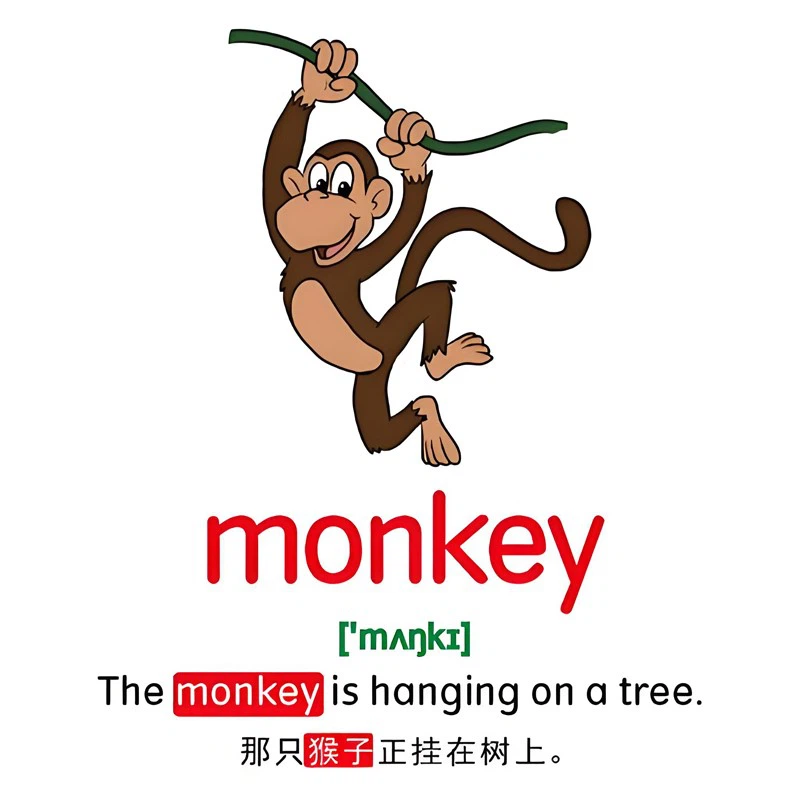
Effective learning is crucial at every stage of learning. When learning, lay out all the animal flashcards and group them by category, such as farm animals, wild animals, and marine animals. Have learners explain their reasoning when grouping them. Flashcards, as a carrier of knowledge, should help children move from simply recognizing to understanding, rather than just memorizing. During learning, ask many "why" questions: "Where does it live?" "What color is its fur?" "What are its abilities?" Continuously expand the knowledge points during the learning process, making learning interesting for children.
Effective learning can follow these principles:
Control duration:Since animal flashcards are primarily designed for children, and children have short attention spans, we recommend each learning session lasting 10-15 minutes, 1-2 times a day. This is more effective than a single 30-minute session;
Timely review:Review is crucial. For example, review before bedtime after learning, and then review again the next day or every few days to prevent rapid learning and forgetting;
Scenario adaptation: When taking children out for a trip, bring several relevant flashcards. When they see real animals, they can refer to the flashcards to recall knowledge points. You can also tell your child a story based on the flashcards, incorporating different knowledge points into the story, which will help them remember better.
Many users wonder how animal flashcards help children's learning. In fact, recognizing animals helps children's cognitive development in many ways, from basic cognition to thinking skills and language development. It offers the following advantages for children's future learning:
Enrich common knowledge:
Let children know about a variety of animals, not only their appearance, but also their habitats and diets. Through the understanding of natural organisms, they will be exposed to simple science such as food chains and ecological environments, improve their visual discrimination ability, and lay a foundation for later learning.
Develop thinking skills:
Classify different animals. In the process of classification, sort out the commonalities and differences of animals, and gradually form logical thinking. Also, develop the ability to summarize by associating animal flashcards with picture book stories, zoo visits and other information to make the memory more solid. You can also expand your thinking.
Enhancing language skills:
Animal names are an important source of children's basic vocabulary. Whether in Chinese or English, they can enrich vocabulary. During the learning process, parents can interact well with their children, create language practice scenarios, and help children gradually transition from simple pronunciation and words to short sentence expressions.
Developing comprehensive abilities
Through learning and play, children's concentration can be improved. Long-term cultivation can enhance focus, which is a core ability for subsequent learning. In the learning process, children can be guided to love animals, and through parent-child interaction, the warmth of family can be conveyed, helping children form a sound emotional cognition.
When customizing animal flashcards, communication is essential to ensure accurate communication of requirements and avoid future disputes. So, what details should we communicate?
Customization requirements: including the size and content of the flashcards, ensuring that the manufacturer can clearly understand the requirements;
Clearly define production capacity: including production experience, minimum order quantity, sampling period, and delivery period, to avoid affecting usage;
Confirm sampling details: Clarify the sampling cost and duration, and make revisions as needed. Sampling is crucial for ensuring large-scale customization, so thorough communication is essential.
For customized animal flashcards, the content must be written down, such as the confirmed quotation, delivery time, and process requirements. Follow up on the production progress, and provide timely feedback on modifications after receiving the samples. Only after the samples are satisfactory should mass production begin.
Hot Tags: animal flashcards, China animal flashcards manufacturers, suppliers, factory, learning cards, Early Childhood Learning Cards, Mental Arithmetic Cards, Language Learning Cards, Science Learning Cards, Educational Toy Cards


